Onsen & Ryokan FAQ: 40 Questions, Clearly Answered
Every onsen and ryokan question answered — ryokan vs hotel, onsen vs sento, etiquette, tattoos, private baths, the best hot spring towns, and what it costs.
This is the reference companion to our bookable onsen experiences — every question travelers actually ask before their first soak, answered in one place. If your main concern is privacy, jump straight to the private onsen in Tokyo options; if it’s ink, the tattoo-friendly onsen in Tokyo guide has you covered. Everything else — from what a ryokan actually is to which town to pick — is below.
1. What is a ryokan and how does it differ from a hotel?
Many travelers assume a ryokan is simply the Japanese word for hotel. The experience is different, and knowing the distinction avoids mismatched expectations. A ryokan is a traditional Japanese inn featuring tatami rooms, futon bedding, seasonal meals (often kaiseki), and communal or private onsen baths, delivered with quiet and attentive hospitality. A hotel prioritizes Western-style beds, private bathrooms, and modern amenities. Ryokan stays emphasize tradition and calm; hotels optimize for convenience.
2. What does the kanji 旅館 (ryokan) mean?
If you’re familiar with Chinese characters you might translate the word literally and oversimplify its meaning. 旅 = travel; 館 = building/lodging. Literally “travel lodging.” Culturally, “ryokan” signals a traditional inn with specific architecture, service, and etiquette — not a generic hotel.
3. How is a ryokan different from a standard Japanese hotel or minshuku?
Multiple lodging types can look similar in photos. The differences matter for comfort and cultural immersion:
- Ryokan: traditional, tatami and futon, set meals (often kaiseki), ritualized service, often with private onsen options.
- Hotel: modern, Western beds, private bathrooms, wide amenity range.
- Minshuku: smaller, family-run, simpler meals and facilities, budget-friendly.
4. What is a minshuku and how does it compare to a ryokan?
Minshuku and ryokan can appear similar from outside but operate differently inside. A minshuku (民宿) is a simpler, often family-run guesthouse with a homely atmosphere and basic meals. A ryokan is more formal and structured with elaborate seasonal cuisine. Minshuku is typically more affordable.
5. What is a futon and how is it used in traditional tatami rooms?
Outside Japan, “futon” often means a foldable sofa. The Japanese bedding is different: a futon is a padded mattress with a quilt placed directly on tatami mats at night and stored away during the day. Staff typically prepare it in the evening and fold it away in the morning.
6. What do tatami, yukata, kaiseki, and other common ryokan terms mean?
A ryokan introduces several cultural terms. Understanding them improves comfort and confidence:
- Tatami (畳): straw-mat flooring.
- Yukata (浴衣): light cotton robe worn in ryokan and onsen towns.
- Kaiseki (会席 / 懐石): seasonal multi-course dinner.
- Onsen (温泉): natural hot spring bath.
- Sento (銭湯): public bath using heated tap water.
- Shōji (障子): sliding paper screens.
- Omotenashi (おもてなし): thoughtful, anticipatory hospitality.
7. Are all communal baths in Japan considered onsen?
No. A communal bath may be an onsen (natural hot spring), a sento (heated tap water), or a standard hotel bath. Only onsen use natural geothermal mineral water.
8. What is the difference between onsen and sento (銭湯)?
These facilities can look similar but differ in water source and purpose:
- Onsen: natural geothermal water with mineral content, legally defined; can include outdoor baths. Day-use fees vary, typically JPY 500–2,000.
- Sento (銭湯): paid public bathhouse using heated tap water; neighborhood-focused, with fees standardized by law (around JPY 500) to keep bathing accessible. The kanji 銭湯 literally reads “coin” plus “hot water.”
9. How can you tell if a bath is true onsen water?
Facilities often promote “hot baths” loosely, so confirmation helps ensure the experience you want. Look for 温泉, 源泉掛け流し (free-flowing from the source), 天然温泉 (natural hot spring), and posted details like 泉質 (mineral composition) and 温度 (temperature). Non-onsen baths rarely publish mineral data. Quick 10-second scan: if a listing only says “large bath” (大浴場) with no mineral table, it may not be a true onsen.
10. How do ryokan communicate that they use real onsen water?
Ryokan clearly highlight their hot-spring credentials. Learning the common terms speeds up evaluation:
- 天然温泉: natural hot spring.
- 自家源泉: private on-site spring source.
- 源泉掛け流し: continuous flow directly from the source.
- 共同源泉: shared spring source in town.
Photos often show outdoor baths, steam, mineral coloration, and posted 泉質 tables.
11. How is natural onsen water delivered to ryokan and bathhouses?
Supply methods vary by geology and town infrastructure, which affects water freshness and temperature:
- Direct source: spring beneath or beside the property (自家源泉).
- Shared pipelines: town-managed distribution (共同源泉).
- Drilled wells: modern geothermal access (掘削温泉).
- Transported water: delivered by pipe or truck (運び湯, less common).
Temperature is maintained with insulation, controlled flow, and occasional gentle reheating when permitted.
12. What is the best way for a first-time visitor to experience an onsen?
Stay one night in an onsen town, enjoy an evening soak, kaiseki dinner, and a morning soak. Choose a ryokan with an outdoor bath (rotenburo). Beginner-friendly towns include Hakone, Kusatsu, Kinosaki, Yufuin, and Noboribetsu. If you’re basing yourself in the capital, a Hakone onsen day trip from Tokyo is the lowest-friction way to try it first.
13. Do all ryokan offer onsen baths?
No. A ryokan may feature onsen baths, regular heated-water baths, or limited facilities. Check the property description for onsen keywords and water details.
14. Do all onsen have ryokan nearby?
No. Some onsen are standalone public baths, natural outdoor pools, municipal facilities, or wellness centers without accommodation. Onsen and ryokan do not always come as a pair.
15. What legally counts as an onsen in Japan?
An onsen is legally defined by the Japanese Hot Spring Law, which requires either a minimum source temperature of 25°C or a specific mineral composition. Sento, by contrast, are regulated under the Public Bathhouse Law with no mineral requirements. This legal definition is why true onsen can display mineral tables — and why the label is worth checking.
16. What is the single most important onsen etiquette rule?
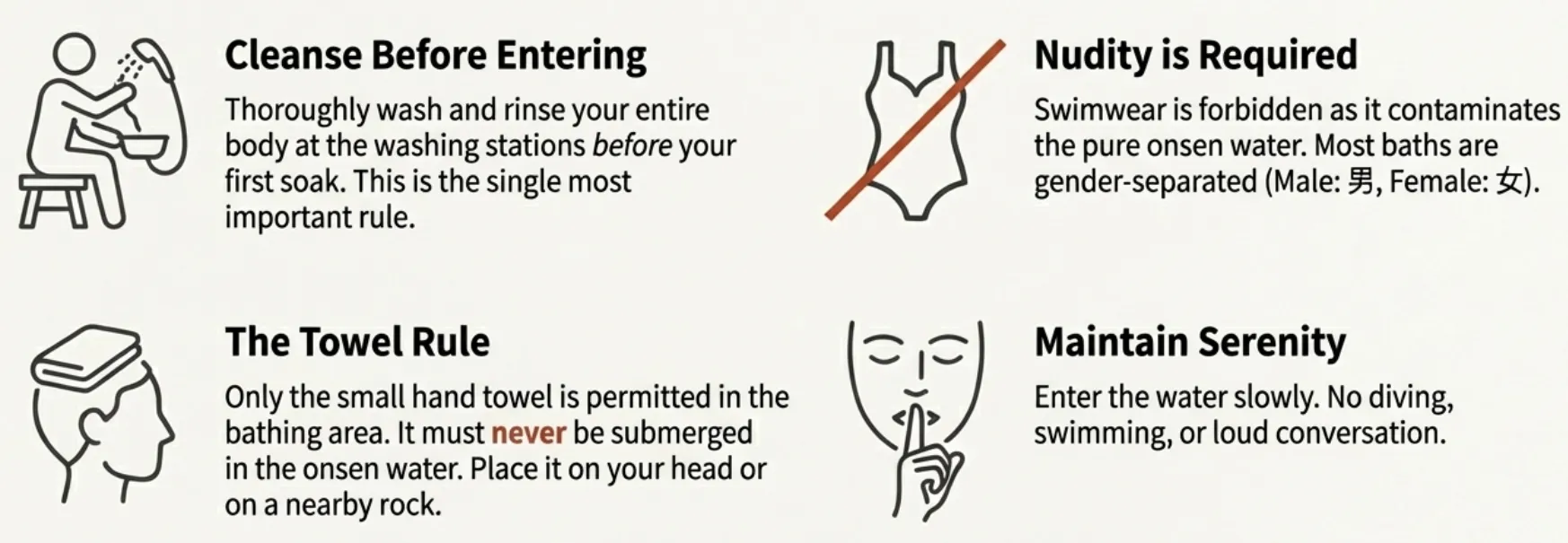
Wash first. Before entering any communal onsen bath, you must thoroughly wash and rinse your entire body at the provided shower stations — low stalls with a small stool and a handheld shower wand. This pre-bathing cleanse is a fundamental sign of respect for other bathers and for the purity of the spring water itself.
The spring water is treated as a pure, shared resource: you arrive clean, you soak quietly, and nothing used to wash your body ever touches the bath.
17. Do I have to be naked in an onsen? Can I wear a swimsuit?
In nearly all traditional onsen, bathing suits are strictly forbidden and full nudity is the standard. Baths are gender-separated, marked with the characters for male (男, otoko) and female (女, onna). If public nudity is a dealbreaker, a reservable private onsen bath removes the issue entirely — it’s the standard workaround for shy first-timers, couples, and families.
18. What do I do with the towels?
You’re typically given two towels. The large bath towel stays in your locker or basket in the changing room. The small hand towel may come into the bathing area for modesty — but it must never touch the onsen water. Bathers place it folded on their head while soaking or set it on a nearby rock or the edge of the tub.
19. What behavior is prohibited in the bath?
An onsen is a place for quiet relaxation. To preserve that atmosphere, the following are prohibited: swimming or splashing, diving or jumping into the water, and loud conversation. Soap and shampoo belong at the washing stations only — never in the bath itself.
20. Can I go in an onsen if I have tattoos?
Sometimes. Roughly 50% of public onsen — particularly traditional establishments — still prohibit visible tattoos, a policy rooted in historical associations with organized crime. Attitudes are slowly changing, but you should plan around the rule rather than hope. The three proven strategies: book a private (kashikiri) bath where the rules don’t apply, cover small tattoos with waterproof patches, or confirm the policy with the facility before booking. For a curated shortcut, see our tattoo-friendly onsen in Tokyo picks.
21. Do tattoo cover patches actually work?
For small tattoos, waterproof adhesive patches are a workable concealment option — but acceptance varies by establishment, so they’re a partial solution, not a guarantee. If your tattoos are large or you’d rather not manage the uncertainty, a private bath or a confirmed tattoo-friendly onsen is the reliable route.
22. What is a kashikiri (private) onsen?
A kashikiri onsen is a private, reservable hot spring bath — the same therapeutic thermal water, enjoyed in complete seclusion. It solves the two most common worries international visitors have (public nudity and tattoo restrictions) in one move, which is why it has surged in popularity. Our private onsen Tokyo page covers the bookable options.
23. What types of private onsen are there?
Two main types. In-room private baths — an exclusive bath, often an open-air rotenburo, attached directly to your ryokan room, sometimes overlooking a garden, mountains, or coastline; listed on booking sites as room types like “Japanese-style room with Open-Air Bath.” Reservable timed baths — a separate private bath within a ryokan or day-use facility that individuals, couples, or families can book by the hour, often marketed as “family baths.”
24. How do I book a private onsen bath?
Four steps: (1) for maximum convenience, book a ryokan room that explicitly includes a private bath; (2) if your accommodation doesn’t have one, reserve a rentable private bath for a time slot — arrange it at booking or check-in, usually for an extra fee; (3) use English-friendly platforms (JAPANiCAN, Jalan.net, or niche services with “private open-air bath” filters); (4) confirm policies in advance, since some traditional ryokan only take reservations by Japanese-language phone or form. If you’d rather skip the logistics entirely, our private onsen experiences in Tokyo are bookable in English with free cancellation.
25. Does onsen etiquette still apply in a private bath?
Yes. Even in the solitude of a kashikiri bath: shower thoroughly at the washing station before entering, keep towels out of the water, and keep swimwear, soap, and shampoo out of the bath. These practices respect the tradition, the spring water, and the facility.
26. Are private onsen good for couples and families?
Yes — that’s exactly what many of them are designed for. Facilities promote reservable private baths as the option for families and couples who wish to bathe together, since communal baths are gender-separated and adults can’t ordinarily share a bath. Timed “family baths” give you the shared experience without booking a premium room.
27. What are the health benefits of onsen bathing?
The heat and mineral content work together to improve blood circulation, increasing the oxygen carried in the blood. The water’s natural buoyancy takes pressure off aching joints, letting muscles relax and recover, which reduces tension and stress. Specific minerals add dermatological benefits: silica softens dry skin, while sulfur can help ease conditions like eczema and psoriasis.
28. What are the 10 official types of onsen water?
Japanese hot spring law classifies onsen water into 10 types by dissolved mineral content, each with a distinct therapeutic profile: Simple (gentle, fatigue recovery), Chloride (salt-rich, heat retention and moisturizing), Bicarbonate (natural cleanser, skin beautification), Sulfate (circulation and wound recovery), Carbon Dioxide (tingling “Ramune” bath, circulation), Iron (reddish water, anemia relief), Acidic (antibacterial, skin conditions), Iodine (rare, disinfectant properties), Sulfur (distinctive odor, milky water, joint pain and skin conditions), and Radium (trace radon, metabolism and deep relaxation).
29. Which onsen water is best for skin?
Bicarbonate springs act as a natural cleanser, removing dead skin cells — the classic “beautifying bath.” Alkaline waters have a similar smoothing effect: Kinosaki’s alkaline springs are known for removing old keratin, and Gero Onsen is famous for water so smooth it’s said to leave skin feeling silky.
30. Which onsen water helps with joint pain?
Sulfur springs — recognizable by their distinctive odor and milky appearance — are considered effective for joint pain as well as skin conditions. Noboribetsu in Hokkaido is renowned for potent sulfur waters sourced from its Jigokudani (“Hell Valley”) crater, and Kusatsu’s highly acidic and sulfur springs are prized for therapeutic bathing.
31. What is toji, the hot water cure?
Toji (湯治) is the ancient Japanese practice of extended hot spring stays for healing — the tradition the modern ryokan experience evolved from. Historically, people would stay near a spring for prolonged periods to treat ailments; today’s one- or two-night ryokan stay is the condensed, comfortable descendant of that wellness ritual.
32. How much does a ryokan stay cost and what’s included?
Ryokan pricing is typically per person, ranging from about JPY 15,000 to JPY 80,000 per person per night. That rate is not just the room: it almost always includes an elaborate multi-course kaiseki dinner, a traditional Japanese breakfast, and unlimited access to the ryokan’s baths. Read it as an all-inclusive cultural package — lodging, fine dining, personal service, and hot springs bundled together.
33. What is a kaiseki dinner like?
Kaiseki is a seasonal multi-course dinner — widely regarded as the highest expression of Japanese culinary art — built around what’s freshest in that region at that moment. At a ryokan it’s usually served as part of your stay rather than ordered separately, and alongside the bath it’s the heart of the experience.
34. Should I stay overnight or just visit a day-use onsen?
Both are valid. An overnight ryokan stay is the full immersion: evening soak, kaiseki, futon on tatami, morning soak. A day-use onsen (higaeri onsen) is the budget-friendly sampler — admission typically runs from a few hundred yen up to about JPY 2,000, letting you try high-quality thermal water while staying in conventional lodging. Many first-timers do a day visit or a guided onsen experience first, then commit to a ryokan night later in the trip.
35. How do I book a ryokan in English?
Traditional inns sometimes have limited English support, so dedicated Japanese reservation platforms help: JAPANiCAN (operated by JTB, Japan’s largest travel company, with full English booking), Jalan.net (one of Japan’s largest reservation services), and the Japan Ryokan & Hotel Association directory of verified traditional inns. For remote properties that only take Japanese-language reservations, booking through one of these intermediaries is the practical bridge.
36. When and where do I wear the yukata?
From check-in onward. The ryokan provides a yukata (light cotton robe), and you’re encouraged to wear it throughout your stay — to dinner, to the baths, and in onsen towns like Kinosaki, out on the streets themselves, paired with wooden geta sandals. Strolling between bathhouses in yukata is part of the experience, not a dress-code violation.
37. What is onsen-hopping and where can I do it?
Several towns are built around visiting multiple baths in one stay. In Kinosaki, ryokan guests receive a pass to the town’s seven public bathhouses and stroll between them in yukata along the willow-lined canal. Kurokawa offers the nyuto tegata pass for its outdoor baths (Rotemburo Meguri), and Gero sells the Yumeguri Tegata, which admits you to the baths of three participating ryokan. It’s the best way to sample different waters without changing accommodation.
38. Which onsen towns are easiest to reach from Tokyo?
Hakone is the classic pick — a well-rounded resort with high-quality springs, Lake Ashi cruises, art museums, and Mt. Fuji views; our Hakone onsen day trip covers it without an overnight. Atami, a retro coastal hot spring town on Sagami Bay with a great seafood scene, is another quick escape. For scenery-first itineraries, a Mt. Fuji onsen tour combines the mountain views with a soak in one day.
39. What are the “Hells of Beppu” — can you bathe in them?
Beppu in Oita Prefecture has the highest number of hot spring sources in Japan, and its most famous attraction is the Jigoku Meguri — a circuit of spectacular superheated springs like the cobalt-blue Umi Jigoku and blood-red Chinoike Jigoku. These “hells” are for viewing only; they’re far too hot to enter. The bathing happens elsewhere in town, including traditional hot sand baths and nearly every classified water type. See the Beppu onsen tour for the guided version, and if wildlife plus hot water appeals, the snow monkey onsen in Nagano is Japan’s other famous “watch, don’t join” spring.
40. Are remote onsen worth the extra effort?
Often, yes — seclusion is the feature, not the bug. The most atmospheric springs tend to be the hardest to reach: at Okukinu Onsen in Tochigi Prefecture, road access ends at a parking lot and day visitors hike 90–120 minutes to reach the ryokan (staying guests arrange a shuttle pickup in advance). That barrier is precisely what preserves the quiet. If your trip can’t absorb that logistics load, a guided day experience delivers the same thermal payoff with none of the planning risk.
Ready to book? If this FAQ answered your questions, the next step is picking your soak: check availability for our featured onsen experience, or browse all bookable onsen tours — private baths, tattoo-friendly sessions, and day trips included.
Ready for Your First Real Onsen?
Join 100+ travelers on the Mt. Takao day tour — cable car, monkey park, Hachioji ramen lunch, and a natural tattoo-friendly hot spring with towels included. Free cancellation up to 24 hours before.
Check Availability & Book